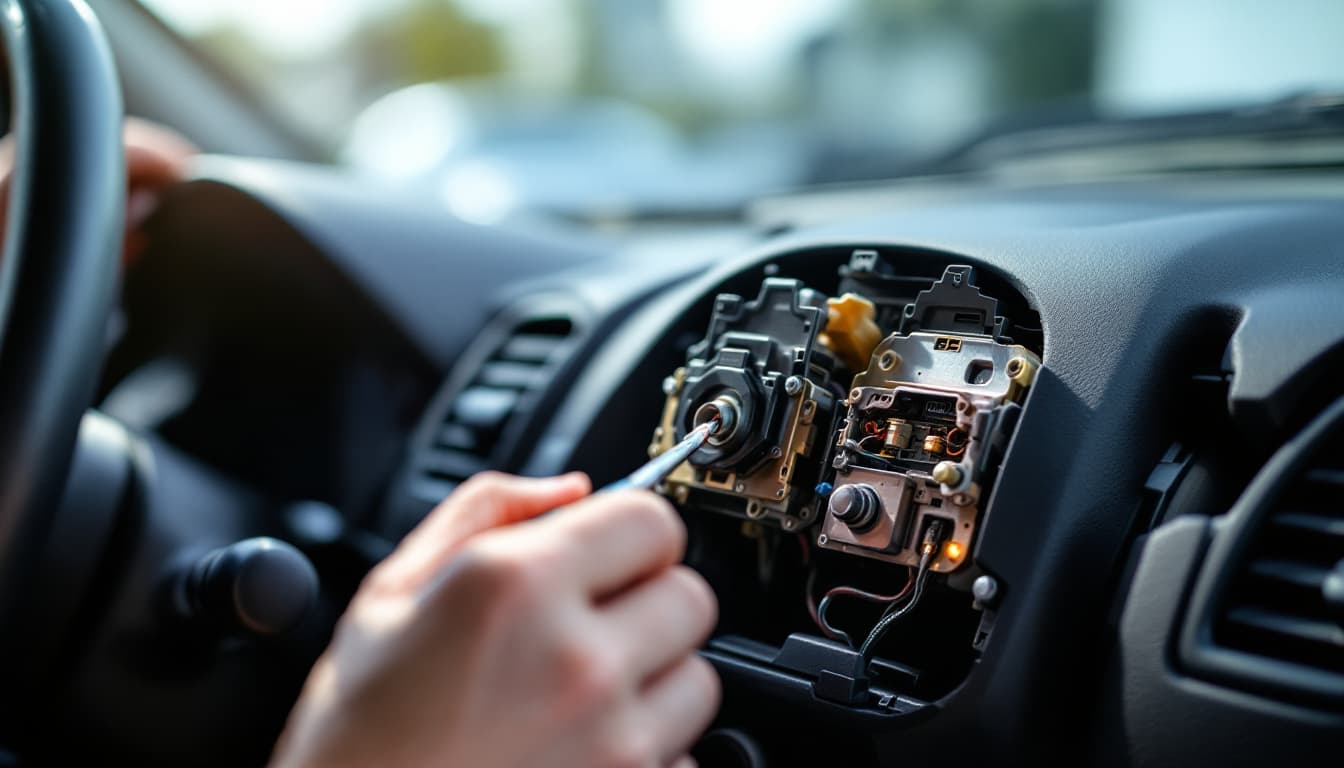
Key Stuck in Ignition Hyundai Southlake
Diagnose why your key won't turn or remove. Common causes & affordable fixes. Call our Southlake Hyundai specialists today: (972) 573-7978.
If your key will not come out of the ignition, the cause is almost always mechanical and it is usually not the ignition itself. Nine times out of ten the car simply does not believe it is in Park, or the steering lock is loaded, and the cylinder is doing exactly what it was designed to do by refusing to return to the LOCK position where the key releases. Southlake TX Locksmiths handles the rest of the cases — worn wafers, bent blades and failed interlock solenoids — on site. Call or text (972) 573-7978.
Quick Answer
A key only comes out of a turn-key Hyundai ignition in the LOCK position, and the car will only allow LOCK when the transmission is fully in Park and the lock cylinder can rotate freely. Anything that blocks either condition traps the key.
In rough order of likelihood: the shifter is not seated in Park, the steering wheel lock is binding, the wafers in the cylinder are worn, the key blade is worn or bent, the shift interlock solenoid has failed, or on push-button cars the 12-volt battery is dead. The first two cost nothing to fix. The rest run from $95 for an extraction to $450 for a cylinder replacement. This is mobile work, so a car that cannot be shut off does not need a tow.
Hyundai Ignition Repair Pricing in Southlake
| Service | Price Range |
|---|---|
| Key extraction from the ignition | $95–$180 |
| Ignition lock cylinder rebuild or rekey | $180–$340 |
| Ignition lock cylinder replacement | $250–$450 |
| Shift interlock diagnosis | $95–$185 |
| Replacement transponder key after blade wear | $150–$280 |
Ranges only, confirmed before work starts. If the fix turns out to be a shifter that was not fully in Park, we tell you that and you have not bought anything.
The causes, in the order they actually occur
Work down this list. It is ordered by how often each one is the real answer, not by how dramatic it sounds.
1. The shifter is not fully in Park
This is the most common cause and the easiest to miss. An automatic-transmission Hyundai will not let the ignition return to LOCK unless the transmission range switch reports Park. A shifter resting a few millimeters short of the Park detent looks like Park to you and reads as something else to the car.
Put your foot on the brake, move the lever to Neutral, then firmly back to Park until it seats. On a slope, the parking pawl can be under load from the vehicle's weight, which physically prevents the lever from fully seating — set the parking brake, take your foot off the service brake so the car settles onto the brake, then try the shifter again. On an Elantra or Tucson parked on one of the steeper driveways around 76092, this alone resolves the problem regularly.
2. The steering wheel lock is binding
When you shut the car off with the front wheels turned, the steering lock pin engages under load. It then holds the cylinder from rotating in either direction, including back toward LOCK.
Apply light, steady rotational pressure on the steering wheel in the direction that relieves the load while gently turning the key. Do not force either one. If the wheel moves a few degrees and the key suddenly frees, that was it.
3. Worn wafers in the lock cylinder
The cylinder is a stack of spring-loaded brass wafers that your key lifts to a shear line. Every start cycle wears them slightly. Once a wafer sits low enough to miss the line, the plug binds, and it commonly binds worst on the rotation back to LOCK because that is the direction with the least mechanical advantage.
Symptom to look for: you have been jiggling the key or wiggling it to start the car for weeks or months before it finally trapped itself. That progression is the fingerprint of wafer wear, and it means the cylinder needs a rebuild or a replacement rather than an extraction alone.
4. A bent or worn key blade
The key wears at the same time and in the same direction as the wafers. A blade that has been carried in a pocket with other keys for eight years, or bent by being used as a pry tool, will not lift the wafers to their correct heights.
There is a useful test. If a second, less-used key comes out cleanly and the daily key does not, the key is the problem, not the cylinder. A fresh transponder key cut to the vehicle's original code frequently resolves the whole complaint. The transponder side of that is covered in our guide to transponder key cutting and programming.
5. A failed shift interlock solenoid
The interlock solenoid is the small electromechanical part that physically permits the key to return to LOCK once Park is confirmed. When it fails, or when its fuse blows, the car is genuinely in Park and the key still will not release.
The distinguishing symptom: the shifter behaves normally, Park is unmistakably seated, the steering wheel is not loaded, and the key still refuses. Some Hyundais also have a small manual override access near the shifter that lets the interlock be released — its presence and location vary by model year, so check your owner's manual rather than prying at trim. Diagnosis here is genuinely diagnostic work, which is why it is priced separately.
6. A dead 12-volt battery on push-button cars
On a push-button Elantra or Tucson there is no key in an ignition at all, so a literal stuck key is not possible. What people describe with the same words is a car that will not power down, will not release the electronic steering lock, or will not recognize the fob.
The overwhelmingly common cause is a weak or dead 12-volt battery. Electronic steering locks draw meaningful current and will refuse to release on low voltage. Charge and retest before anyone touches the column. If the fob itself is suspect, note that a proximity fob with a dead coin cell can usually still start the car by holding it against a marked spot on the column or console — the exact location varies by model.
Which Hyundai do you have
The generation determines whether you even have a lock cylinder.
Elantra, 2017 to 2020 (AD). Turn-key ignition on base and mid trims, push-button on higher trims. The turn-key cars in this range are the ones now reaching the mileage where wafer wear appears.
Elantra, 2021 onward (CN7). Push-button start is far more widespread. Complaints shift toward the fob, the start button and the electronic steering lock.
Tucson, 2016 to 2021 (TL and TL facelift). Mixed. Base trims commonly turn-key, upper trims push-button.
Tucson, 2022 onward (NX4). Push-button standard across most of the range.
The fast test remains the simplest one: if you insert and rotate a key, you have a cylinder that can wear. If you press a button, you do not.
What we do on site
Mobile matters here more than on most jobs, because a car with a trapped key often cannot be shut off, and one that cannot be shut off cannot be safely towed with the steering unlocked.
Ownership verification comes first — registration, title or an insurance card showing the VIN, plus a matching photo ID. Ignition access is exactly what a thief wants, and any shop that skips that step is telling you how it operates.
We then work the free causes before the paid ones. Park seating, steering preload, battery voltage. It costs us a few minutes and it saves customers money often enough that we consider it part of the job rather than a courtesy.
If the key genuinely has to come out of a bound cylinder, extraction is done without destroying the plug where that is possible, because a salvageable plug is the difference between a rebuild and a replacement. Once the cylinder is out, we make the rebuild-or-replace call in front of you.
If a new key is cut, the transponder has to be registered to the vehicle or the engine will crank and stall within a second or two — the classic immobilizer signature. Our overview of Hyundai key replacement and the anti-theft system covers that side, and the same cylinder decision on a GM car is walked through in our note on Malibu and Impala ignition lock cylinders.
If your key is not stuck but simply will not rotate to start, that is a related but distinct diagnosis — see why a car key will not turn in the ignition.
What not to do
Do not force the key. A blade twisted hard enough will snap, and a broken blade inside a bound cylinder converts a $95 extraction into a much larger job.
Do not spray oil-based lubricant into the cylinder. WD-40 and similar products wash out the intended lubricant and then collect pocket lint and grit into a paste. If anything goes in, it is dry graphite, and even then sparingly.
Do not pry at the shifter trim looking for the interlock override. On some models there is no accessible override at all, and broken trim clips are not covered by anything.
Do not leave the car unlocked with the key in it. If the key is trapped and the car is on a public lot, that is an unattended running or accessible vehicle. Call before you walk away from it.
Frequently Asked Questions
Why is my car key stuck in the ignition? Because the cylinder cannot return to the LOCK position, which is the only position where the key releases. The car blocks LOCK when the transmission is not fully in Park, and the cylinder physically cannot rotate there when the steering lock is loaded or the wafers inside are worn. Check Park and steering preload first, since both are free to resolve.
My Hyundai is definitely in Park and the key still will not come out. What now? That points at either wafer wear inside the lock cylinder or a failed shift interlock solenoid. The distinguishing clue is history. If you have been jiggling the key to start the car for weeks, it is the cylinder. If the key has always worked perfectly and this happened suddenly, the interlock is the more likely culprit.
Can you get a key out of the ignition without breaking anything? In most cases yes. Extraction from a bound cylinder is done in a way that preserves the plug wherever possible, because a salvageable plug is the difference between a cheaper rebuild and a full cylinder replacement.
Does a stuck key mean I need a whole new ignition? Not usually. A worn cylinder can often be rebuilt with new wafers and rekeyed to a fresh cut rather than replaced outright. A full replacement is reserved for cylinders that have been forced, previously disassembled, or physically damaged.
Why does my Hyundai crank and then die after I get a new key? That is the immobilizer. The engine fires but the transponder chip in the new key was never registered to the vehicle, so it is shut down within a second or two. Registering the key fixes it, and it has nothing to do with the mechanical ignition work.
Do you come to the car, or do I have to get it somewhere? We come to the vehicle in Southlake, Colleyville, Keller, Grapevine, Westlake or Trophy Club. That matters on this job specifically, because a car with a trapped key often cannot be shut off or steered normally.
Key stuck in the ignition on an Elantra or Tucson in Southlake, Colleyville, Keller, Grapevine, Westlake or Trophy Club? Text your year, model and exactly what the key and shifter are doing to (972) 573-7978. If the answer is a shifter that is not fully seated, we will tell you that on the phone and you will not owe anyone anything.
Written by the Southlaketxlocksmiths Automotive Locksmith Team — mobile automotive key and module programming across Southlake TX 76092 and the surrounding communities.