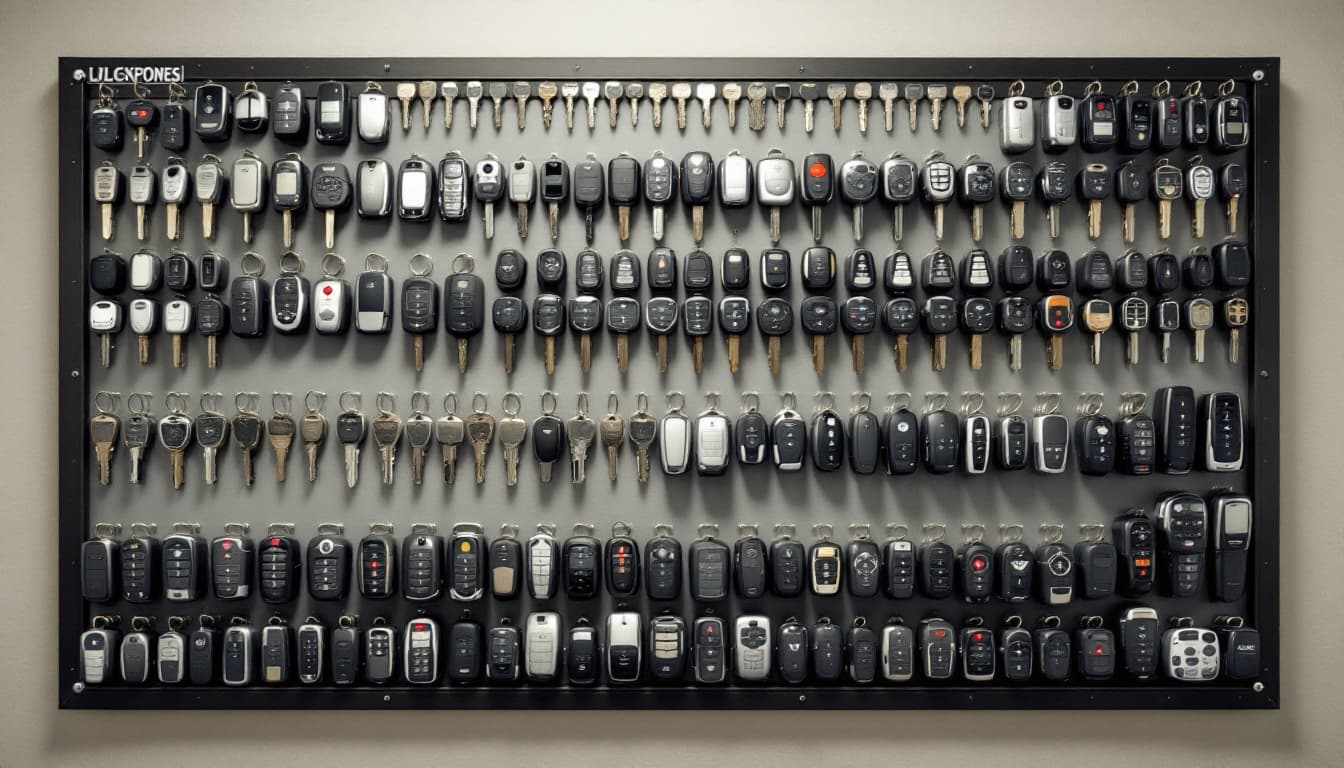
Car Key Coverage by Make — What a Southlake Auto Locksmith Can Do On Site
Which makes and model years a Southlake auto locksmith can key, program and repair on site in 2026 — and the handful of cases that genuinely need a dealer. (972) 573-7978.
The question behind most calls we get is simple: can you actually do my car, or am I going to end up at the dealership anyway? This is the honest answer, make by make, including the cases where a dealer really is the better path. Southlake TX Locksmiths works on site across Southlake, Colleyville, Keller, Grapevine, Westlake and Trophy Club. Call or text (972) 573-7978 with your year, make and model.
Quick Answer
As of August 2026, a properly equipped mobile auto locksmith covers the large majority of vehicles on North Texas roads — including all-keys-lost situations — for roughly $150–$450 on mainstream makes and $390–$950 on European luxury and recent proximity-key systems.
The pattern that predicts difficulty is not the badge on the hood. It is how the manufacturer protects immobilizer data. Vehicles that expose key programming through the diagnostic port are quick and inexpensive. Vehicles that wrap the credential in protected data — most European luxury from roughly the mid-2010s onward — take longer and cost more. A handful of very recent variants are genuinely dealer-preferred, and we tell you that on the phone rather than after we arrive.
Coverage and Typical Cost by Make Group
| Make group | Typical spare key | All keys lost | Notes |
|---|---|---|---|
| Toyota / Lexus | $180–$390 | $290–$620 | Broad coverage; proximity systems take longer |
| Honda / Acura | $170–$370 | $280–$580 | Some models expect two keys registered |
| Ford / Lincoln | $160–$360 | $270–$620 | PATS-based; strong coverage across the range |
| Chevrolet / GMC / Buick / Cadillac | $150–$340 | $260–$560 | Relearn procedures vary widely by year |
| Chrysler / Dodge / Jeep / Ram | $170–$380 | $290–$600 | RF hub module involvement on newer models |
| Nissan / Infiniti | $180–$390 | $300–$640 | Registration-based system |
| Hyundai / Kia / Genesis | $180–$400 | $300–$660 | Newer smart keys need current equipment |
| Subaru / Mazda / Mitsubishi | $170–$380 | $290–$600 | Straightforward on most years |
| Volkswagen / Audi | $290–$650 | $480–$950 | Protected immobilizer data on newer platforms |
| BMW / Mini | $300–$680 | $500–$980 | Varies sharply by generation |
| Mercedes-Benz | $350–$720 | $550–$1,100 | Newer generations are the most involved |
| Volvo / Land Rover / Jaguar / Porsche | $290–$700 | $450–$1,000 | Model and generation dependent |
Ranges only, and the spread within each row is real. Two vehicles wearing the same badge ten years apart can differ by several hundred dollars. We quote your specific VIN before dispatch.
What actually determines whether your car is easy or hard
Four factors, in order of impact.
Immobilizer generation. This is the big one. A 2008 vehicle typically stores key credentials somewhere a diagnostic tool can reach with the right authorization. A 2020 European vehicle often stores them inside protected data that has to be read, decoded and rewritten. Same brand, different decade, entirely different job.
Whether a working key exists. Adding a spare to a car that already runs is the cheap version. All keys lost means starting from nothing — no credential to copy, no vehicle that can be driven anywhere, and on many makes a full rebuild of the authorized key list. The gap is commonly $150–$400.
Key type. A basic transponder key is cheaper than a remote head key, which is cheaper than a proximity smart key, which is cheaper than a display or digital key. The electronics inside drive the parts cost independent of the programming labor.
Model year recency. The newest model years are the ones where aftermarket key supply and tool support are thinnest. A vehicle from the current or previous model year is where "dealer only" is most likely to be a real answer rather than an excuse.
The mainstream makes: broad coverage, quick jobs
Toyota, Honda, Ford, GM, Nissan, Hyundai, Kia, Subaru, Mazda and the Chrysler group make up most of what we key, and coverage on these is deep across roughly two decades of model years.
Common jobs on these vehicles run from thirty minutes to about ninety. A spare transponder key for a mid-2010s sedan is often done in half an hour. A proximity smart key on a recent SUV takes longer because the registration procedure is more involved, and all-keys-lost adds time on top.
Some make-specific quirks are worth knowing in advance. GM relearn procedures differ substantially by year and platform — a procedure that works on one Chevrolet will not on its cousin. Several Honda and Acura models behave best when two keys are registered together. Nissan and Infiniti use a registration flow where the number of keys present at the time matters. Our write-ups on Toyota Sienna and Prius spare keys, Honda HR-V and Passport spare keys and Ram 1500 and Durango ignition repair cover representative examples in detail.
European luxury: doable, slower, more expensive
BMW, Mercedes-Benz, Audi, Volkswagen, Volvo, Porsche, Land Rover and Jaguar are all workable — but they are where model year matters most, and where the honest answer occasionally is "the dealer is your better path."
The reason is architectural. These manufacturers moved earliest and hardest toward protecting immobilizer data against exactly the kind of access that makes key programming possible. On a modern BMW the key is tied to a body-domain controller with its own security scheme. On Mercedes the electronic ignition switch and the key exchange credentials in a way that resists generic tools. Volkswagen Group uses component protection, which binds modules to the vehicle.
None of that makes the work impossible. It makes it slower, requires more specialized equipment, and pushes the price up. Budget ninety minutes to three hours rather than thirty minutes, and expect the ranges in the table above. Our detailed pieces on Audi A6/A7/A8 all keys lost, Mercedes W211/W212 Keyless-Go keys and Porsche 911 and Cayman key replacement show what each of these actually involves.
Electric vehicles and digital keys
EVs do not change the fundamentals — the immobilizer logic is the same category of problem — but two things are different.
Digital keys. Phone-as-key systems layer on top of the physical key rather than replacing it. Your vehicle still has a registered physical credential, and that is what we work with. Losing your phone is an account problem, not a locksmith problem.
High-voltage caution. We work on the 12-volt and body-electronics side. Nothing about key programming requires touching a traction battery, and a reputable technician will not.
Our note on BMW i4 and iX digital key replacement and on Ford F-150 Lightning key replacement cover how this plays out on two very different EVs.
Beyond keys: what else gets done on site
Key cutting and programming is the visible half of the work. The rest:
Ignition repair. Worn lock cylinders, keys that will not turn, keys stuck in the ignition. Usually repairable on site without a tow.
Immobilizer and module programming. When the fault is not the key but the module that authorizes it — body control modules, immobilizer units, engine controllers that need VIN coding after replacement. Our Mazda PCM and immobilizer module programming piece is a good example of what that job actually involves.
Broken key extraction. A blade snapped in a door or ignition, retrieved without damaging the lock.
Diagnosis. Frequently the most valuable thing we do. A meaningful share of "I need a key" calls turn out to be weak batteries, failed modules or aftermarket accessories. Selling you a key you did not need is a bad outcome for both of us.
When the dealer is genuinely the right call
We would rather say this plainly than have you discover it after paying a service fee.
Very recent model years where aftermarket key supply has not caught up. Usually the current or immediately previous model year on low-volume models.
Rare or low-volume variants — specialty performance models, imported configurations, commercial chassis with unusual equipment.
Vehicles under an active recall or campaign touching the immobilizer or body electronics, where the manufacturer's procedure should be followed.
Cases where you cannot prove ownership. This is not a technical limit. Programming a key to a vehicle is precisely the capability a car thief wants, so verification is not optional — for us or for anyone reputable. Registration, title or an insurance card showing the VIN, plus a photo ID matching that name.
If your situation is one of these, we say so on the phone. That is a shorter conversation than a wasted trip.
What to have ready when you call
Four things make the quote accurate and the visit efficient:
Year, make and model — and the trim if you know it, since trim frequently determines key type.
The VIN. It settles platform and key type questions that model year alone cannot. Text a photo of the door jamb sticker or the windshield plate.
Whether you have a working key. The single biggest cost variable.
Where the vehicle is. Driveway, workplace, parking garage. We come to the vehicle, which matters most when it cannot be driven. If you want a sense of how the on-site and shop paths compare, our note on on-site versus shop service covers the trade-offs, and our pricing explainer breaks down where the money goes.
Frequently Asked Questions
Which cars can a locksmith make keys for? The large majority of vehicles on the road, spanning roughly two decades of model years across all mainstream makes and most European luxury brands. The exceptions cluster in very recent model years, rare variants, and cases where ownership cannot be verified.
Is an auto locksmith cheaper than the dealership? Usually, and the gap is widest when the vehicle cannot be driven — a dealer visit on a car with no working key starts with a tow. On common vehicles the difference is often $80–$200; on European luxury it can be several hundred. On very recent models the gap narrows and occasionally reverses.
How long does car key programming take? Thirty to ninety minutes for most mainstream vehicles with a working key present. Ninety minutes to three hours for European luxury or all-keys-lost situations. We give a realistic window when we quote, not an optimistic one.
Do you come to me in Southlake? Yes — Southlake 76092 plus Colleyville, Keller, Grapevine, Westlake and Trophy Club. Mobile service exists precisely because a car with no key cannot come to us.
What do I need to prove the car is mine? Registration, title or an insurance card showing the VIN, plus a photo ID matching that name. For company vehicles, leased vehicles or a driver who is not the titled owner, call ahead so authorization can be arranged before dispatch.
Can you make a key with just the VIN? The VIN tells us the key type and lets us prepare the correct blank, and in many cases the cutting code. It is not by itself authorization — ownership verification is still required, and for good reason.
Not sure whether your vehicle is a thirty-minute job or a three-hour one? Text your year, make, model and VIN to (972) 573-7978 and we will tell you exactly what it takes and what it costs before anyone drives out.
Written by the Southlaketxlocksmiths Automotive Locksmith Team — mobile automotive key cutting, programming, ignition repair and module work across Southlake TX 76092 and the surrounding communities.